
What We Do
The Work Behind the Sales Dashboard.
Building an e-commerce business takes more than getting products listed. We manage the strategy, sourcing, setup, fulfillment, marketing, and day-to-day operations that keep the business moving.
OUR APPROACH
01
Getting Started
Initial consultation, business assessment, service agreement, account onboarding, supplier and product research, inventory and launch, and ongoing growth: seven steps, each with a defined outcome.
02
The First Month
We assess your goals, budget, and risk to determine the right platform mix. We secure products, establish accounts or storefronts, and prepare them for launch. Select the right fulfillment approach for each product and platform.
03
Beyond Launch
Optimization continues from month two, with pricing, ad spend, and inventory refined using real data. Reporting and growth continue on an ongoing basis, with a clear next step at every stage, platform by platform.
04
What You Can Count On
A written account plan before we touch your budget. Regular check-ins during setup and launch. Full visibility into every sourcing, fulfillment, and advertising decision. Every decision tied to data.
CASE STUDIES
How we operate, by category
We don’t publish client names, revenue figures, or dashboard screenshots. Client confidentiality matters more to us than a compelling homepage graphic. The scenarios below are illustrative examples of our operating approach in a few representative categories, not specific client accounts. They’re built the same way we’d walk a prospective client through our thinking in a private consultation. Real, anonymized account context, including current performance, is something we discuss directly with prospective clients once we understand their goals.

- Illustrative Scenario: Home & Kitchen, Amazon
Situation. A product category with clear year-round demand but a crowded competitive set, and no existing sales history or brand presence to build from.
Approach. In a category like this, we’d typically source from a distributor with consistent stock depth rather than a single supplier, to avoid the stockout risk that kills momentum in a competitive category. Listings would be built around the specific search terms buyers in that category actually use, not generic category keywords. Fulfillment would run through FBA for Prime eligibility from day one, with early advertising spend concentrated narrowly on high-intent keywords rather than spread thin across a broad match strategy.
Objective. The goal in a scenario like this is to move the account from zero sales history to a stable, repeatable position on its core search terms, with organic ranking improving as review velocity builds — allowing paid spend to gradually pull back without losing placement. That’s the sequence we aim for on every launch in a competitive category.
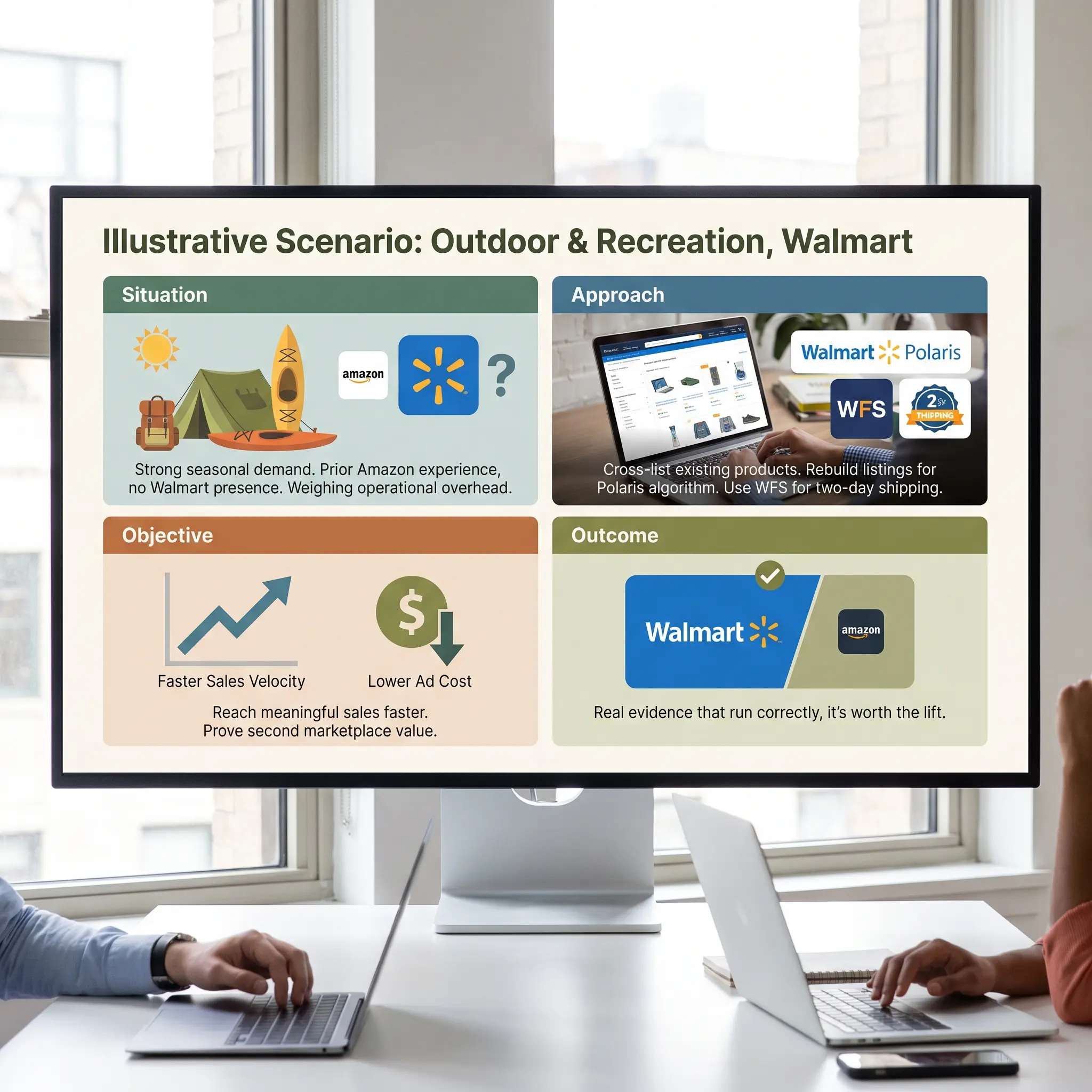
- Illustrative Scenario: Outdoor & Recreation, Walmart
Situation. A category with strong seasonal demand where a client has prior Amazon experience but no presence on Walmart, and is weighing whether a smaller marketplace is worth the operational overhead of a second platform.
Approach. We’d typically cross-list an existing product line rather than sourcing new inventory, using Walmart’s lower seller density in the category as an advantage. Listings would be rebuilt specifically for Walmart’s Polaris search algorithm rather than ported directly from Amazon, since the two platforms rank differently. WFS would be used for the two-day shipping badge, which tends to matter more for conversion on Walmart than identical fulfillment speed does on Amazon.
Objective. In a scenario like this, the aim is for the Walmart account to reach meaningful sales velocity faster than the client’s original Amazon launch did, at a lower relative advertising cost per sale — giving the client real evidence that a second marketplace, run correctly rather than as an afterthought, is worth the operational lift.
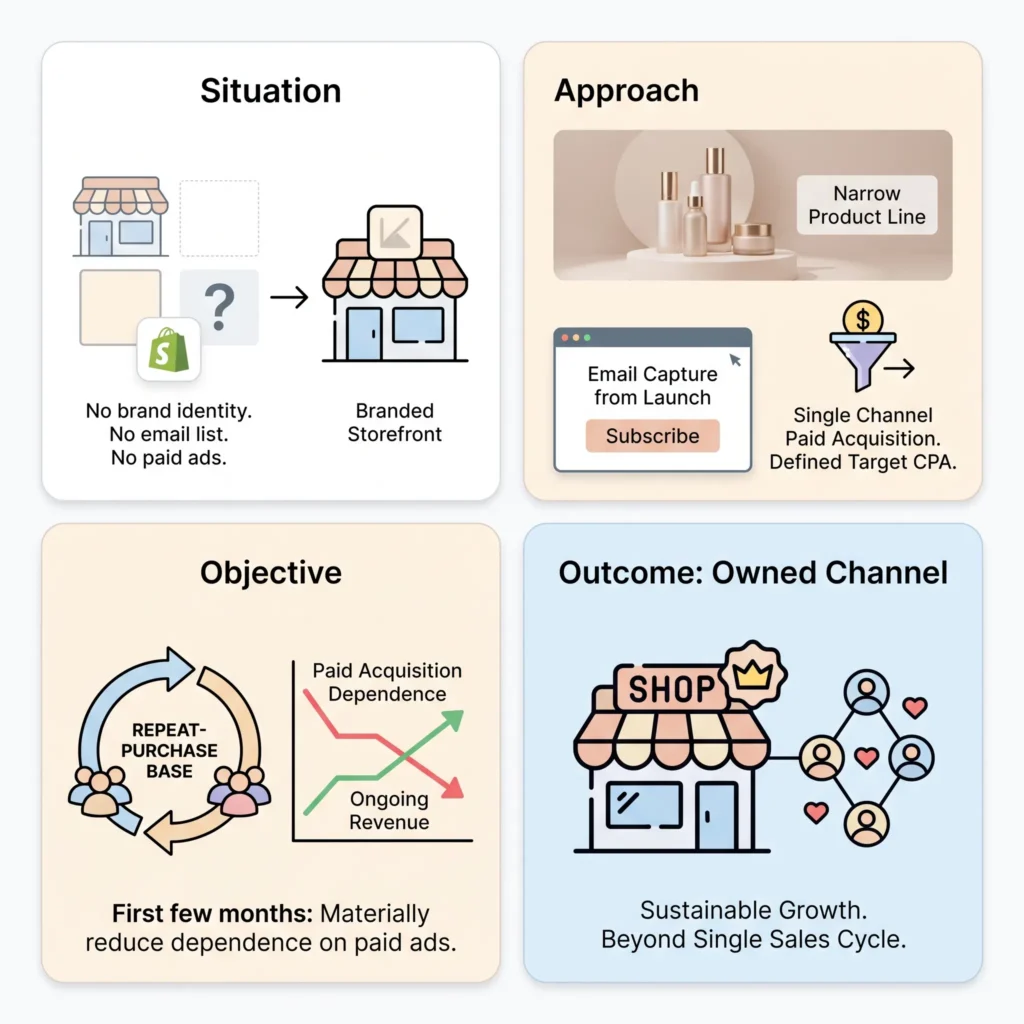
- Illustrative Scenario: Beauty & Personal Care, Shopify
Situation. A client wants to move beyond marketplace-only sales into a branded storefront, with no existing brand identity, email list, or paid acquisition experience to build from.
Approach. We’d typically build the Shopify storefront around a narrow initial product line rather than a broad catalog, to keep early advertising spend focused and measurable. Email capture would be built into the storefront from launch day, not added later, so the first cohort of buyers can be retained rather than lost after a single purchase. Paid acquisition would start on a single channel with a clearly defined target cost per acquisition before any budget moves to a second channel.
Objective. The goal is a storefront that builds a repeat-purchase base within its first few months, materially reducing dependence on paid acquisition for ongoing revenue. That’s the specific outcome an owned channel is meant to produce, and the reason we recommend it to clients thinking beyond a single sales cycle.
READY TO BUILD YOUR E-COMMERCE BUSINESS?
Let’s discuss your goals, your starting point, and the right path forward.